
Juliane Koepcke fell two miles from the sky strapped to an airplane seat and landed alive in the thick Amazon jungle. She was only seventeen years old. It was Christmas Eve in 1971, and everyone else on that plane died.
She did not panic or give up. Instead, she stood up with a broken collarbone, a deep cut on her arm, and one swollen eye, and she walked through the wild forest for eleven days until she found help. Here is how a teenage girl survived a drop from the clouds and beat impossible odds.
The Flight That Broke Apart in the Storm
Juliane and her mother, Maria Koepcke, boarded LANSA Flight 508 in Lima, Peru. They wanted to fly to Pucallpa to meet Juliane's father, Hans-Wilhelm Koepcke, for Christmas. Both of her parents were famous zoologists who ran a research station deep in the woods. Juliane had spent nearly two years living with them in the wild, which turned out to be the reason she lived.
About twenty minutes before landing, the plane flew straight into a massive wall of black clouds. Lightning flashed all around them. The Lockheed L-188 Electra turboprop began to shake violently. Luggage tumbled out of overhead bins, and gifts flew through the air as passengers cried and screamed.
Then, a bolt of blinding light hit the right wing. Maria turned to Juliane and whispered very calmly, "This is the end, it is all over." Those were the last words Juliane ever heard from her mother.
The plane nose-dived into an uncontrolled spin. Within seconds, the aircraft literally ripped apart in mid-air. Juliane felt the roaring wind tear away the metal walls. One second she was inside a loud, crowded plane, and the next second she was outside in the freezing rain, falling through empty space while still tied to her row of three seats.
The rush of air knocked her out cold. She did not wake up as she dropped ten thousand feet toward the green canopy below. Trees with thick branches and bouncy vines broke her fall, acting like a giant net before she hit the muddy ground.
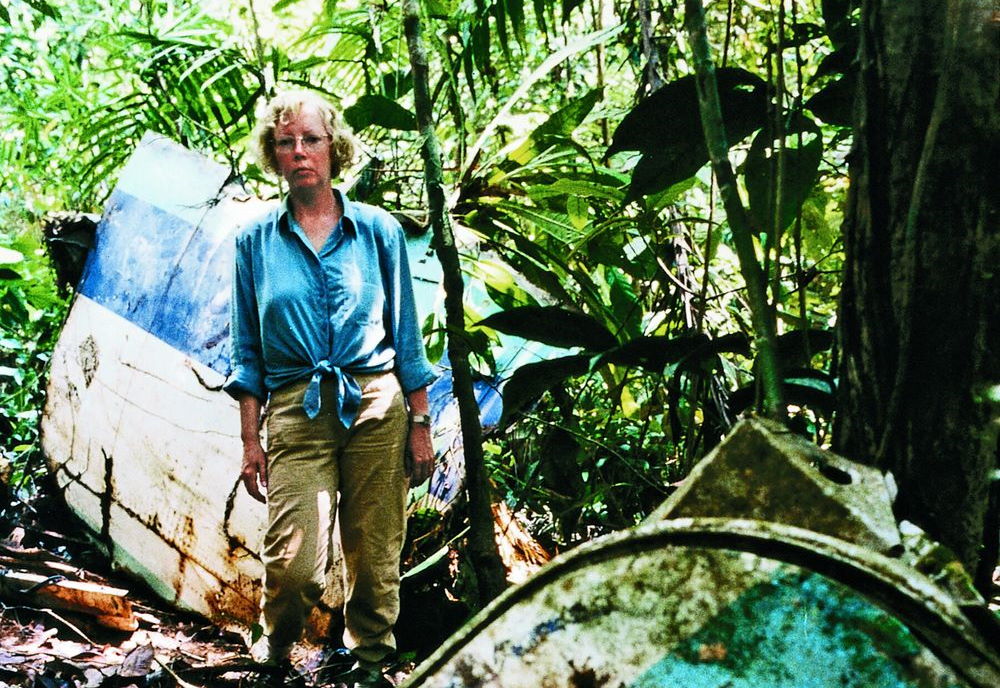
Waking Up Alone in the Amazon
When Juliane opened her eyes on Christmas Day, the jungle was quiet. The loud engines were gone. Sunlight cut through the high leaves, and she realized she was lying on the dirt under her seat bench. It took her hours to fully wake up because she had a severe concussion.
Her injuries were bad. Her right collarbone was snapped in two, her right knee was sprained, and she had a deep gash on her right arm. She had lost her glasses, which left her nearly blind in the woods. She had only one shoe and was wearing a simple mini-dress that was now torn and wet.
She called out for her mother again and again. Nobody answered. Only the buzz of insects and the calls of birds filled the hot, humid air. She found a bag of hard Christmas candies near the wreckage, and that small bag became her only food for the next week and a half.
Many readers of this classic human-interest story wonder how a lone girl did not freeze or lose her mind right there. The truth is simple: she relied on what her father had taught her about the wild.
How Did Juliane Koepcke Walk Out of the Jungle?
Juliane remembered one golden rule from her father: if you are lost in the jungle, always look for water. A tiny trickling spring flows into a small brook. A brook runs into a creek, and a creek leads to a large river. Big rivers are where people live and travel, because humans build towns near waterways.
She found a small stream nearby and stepped into the water. Walking in the stream was safer than walking through the dense bushes. On the shore, deadly snakes rested under dry leaves, hidden from view. Fallen logs hid giant spiders and stinging ants. By wading in the center of the shallow water, she could see where she placed her bare foot and keep moving in one direction.
The jungle tested her at every turn. Rain poured down daily, soaking her clothes and skin. At night, it became freezing cold, and she had no shelter. She could not sleep because swarms of mosquitoes bit her raw skin. She heard rescue planes flying high above the trees, but the forest was too thick. The pilots could not see a small girl through the green roof, and she soon realized that nobody was coming down to grab her. She had to save herself.
Her knowledge of basic survival skills kept her alive during those long days. She did not eat wild fruit because she knew many bright berries in the Amazon carried deadly poison. She sucked on her few candies, one by one, until they dissolved away. After four days, the candy was gone, and she drank only dirty brown river water to keep her belly full.
The Battle Against Flies and Despair
By the ninth day, Juliane was weak and dizzy. Her arm wound had turned into a nightmare. Blowflies had laid eggs in the cut, and dozens of maggots were eating into her skin. She could feel them moving inside her flesh, and she was terrified she would lose her arm or die from blood poisoning.
Still, she kept drifting down the river, which had grown wider and deeper. She had to float on her back now because the water was over her head. Swimming with one good arm was exhausting. She kept an eye out for stingrays in the mud and black caimans resting on sandbanks, but she was too tired to run even if danger came close.
On the tenth afternoon, she saw something that looked like a mirage. Resting on a riverbank was a small wooden boat with an outboard motor. Near the boat, a narrow path led up a hill to a tiny wooden hut without walls, covered with a roof made of palm fronds.
Juliane crawled up the bank on her hands and knees. The hut was empty, but it felt like paradise. She lay down on the hard floorboards and waited. Inside the hut, she spotted a can of gasoline used for the boat motor. Remembering an old trick her father used on farm animals, she poured the fuel directly into her infected arm wound. The burning pain was sharp and intense, but it worked. Over thirty maggots crawled out of her flesh, and she picked them out one by one with a stick.
The Rescue and the Aftermath
The next morning, three local Peruvian lumbermen named Jeronimo Jimenez, Aloisio Amasifuen, and Manuel Saenz walked up to the hut. They stopped in shock. Before them sat a pale, blond, bruised girl who looked like an apparition. At first, they thought she might be a water spirit from local folklore, but Juliane spoke to them in clear Spanish.
She told them who she was and that she had come from the LANSA plane crash. The men fed her roasted cassava, washed her wounds with clean water, and treated her with great kindness. They put her in their canoe and paddled her downriver for seven long hours until they reached the small town of Tournavista.
From there, a local pilot flew her to the hospital in Pucallpa, where her father was waiting. Out of ninety-two people aboard that fateful flight, Juliane Koepcke was the sole survivor. You can find more accounts about people who beat the odds on our page of unbelievable real survival records.
Juliane did not let this tragedy break her spirit. She grew up to study biology just like her parents, earning her degree in Germany. She later returned to Peru many times to protect the very rainforest that almost took her life. If you love discovering how regular people show courage during unexpected crises, check out our collection of real human courage moments.
Her story reminds us of something simple: when everything falls apart, you only need to take the next step. Keep following the river, stay calm, and keep moving forward.
Comments
Post a Comment