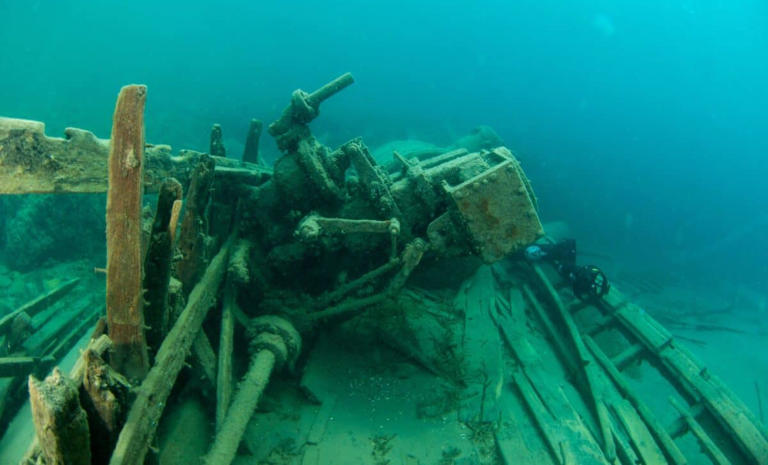
In 2019, marine explorers found a 500-year-old ship sitting perfectly upright at the bottom of the Baltic Sea. The wooden vessel looked like it had sunk just yesterday, with its masts, bowsprit, and even its tiny deck swivel guns still sitting right where the sailors left them. It is one of the best preserved shipwrecks ever discovered in human history.
Scientists named the wreck Ok\u00e4nt Skepp, which means Unknown Ship in Swedish. It sank during the Renaissance era, around the time Christopher Columbus was sailing to the Americas. Because the icy waters of the Baltic Sea lack oxygen and wood-eating worms, the entire wooden ship stayed complete for over five centuries in total darkness.
How the Unknown Ship Was Found So Deep Underwater
A team of ocean researchers was surveying the seabed using underwater radar equipment. They knew the Baltic Sea held many secrets, but they did not expect to find an entire ship standing tall on its keel. The sonar showed a clear shape resting nearly 450 feet beneath the cold blue surface.
When the team lowered a robotic camera into the black water, the lights lit up something incredible. Main masts reached up toward the surface. The wooden hull showed no large holes from cannon fire or massive storm damage. The team sat in the control boat above, staring at their monitors in absolute shock.
Most old wooden boats crumble into pieces when they sink. Saltwater, strong currents, and tiny sea creatures usually eat away the timbers until nothing remains except iron nails and heavy anchors. On this boat, even the fine ropes attached to the main mast were still intact after hundreds of years.

Why the Baltic Sea Kept This Ship Intact
The secret to this discovery lies in the special water of the Baltic Sea. Deep ocean water in this region has almost no oxygen. Without oxygen, bacteria cannot grow quickly enough to rot wooden planks. The water is also freezing cold, keeping everything in a natural deep freeze.
There is another big reason for this miracle. A tiny creature called the shipworm lives in most salt oceans around the world. These worms eat through wooden hulls like termites eat through houses. But the Baltic Sea has very low salt levels, so shipworms cannot survive there at all. If you want to understand how sailors built boats long ago, learning about oral history and old building methods gives us huge clues.
Because of these exact conditions, the ship sat in total peace. No heavy fishing nets ever dragged across its deck. No sea storms could shake it at such a deep level. It just stayed there, frozen in time, waiting for modern technology to find it.
What Sailors Left Behind on the Wooden Deck
When researchers sent smaller underwater drones closer to the deck, they saw tiny everyday details. The ship carried small swivel cannons used to defend against pirates. These guns were still mounted on their wooden swivels, ready to fire. You could see the wooden haul blocks used to pull heavy ropes.
The crew likely had to jump off the boat very fast. There was a small tender boat sitting on the main deck, used to carry sailors to the shore. Usually, sailors would use this small boat to save themselves if the main ship started taking on water. Why did they leave it behind? Nobody knows for sure.
It feels very personal to look at these images. You see the work of human hands from the year 1500. Someone carved those beams, tied those knots, and cooked meals on that deck. If you love reading about real events that feel impossible, check out anchor text about the topic to find more amazing accounts from history.
Why Did the Unknown Ship Sink Straight Down?
How does a boat sink and land perfectly flat on the bottom of the ocean? Usually, when a ship takes on water, it flips over, snaps its masts, or breaks its spine when it hits the sand. A ship landing straight up is a rare event that requires precise physical conditions.
Naval experts think the ship filled with water very evenly. If water enters the hull from all sides at the same rate, the weight stays balanced. The heavy iron cannons and ballast stones in the bottom acts like a heavy weight. This weight pulls the keel down first, keeping the boat upright as it glides through the dark water column.
Think about dropping a small plastic toy straight down into a bucket of water. If it is weighted correctly at the bottom, it will sink straight to the floor without tipping over. That is exactly what happened to this ship 500 years ago. It slowly glided down 450 feet until its wooden belly gently touched the soft mud.
What This Ship Teaches Us About the Past
Before this boat was found, historians only had drawings and small sketches of early Renaissance trading ships. Nobody had ever seen a complete example with all its decks and masts still connected. This single discovery answered decades of questions about old marine engineering.
The ship was built during a time when maritime trade was changing the world. Modern trade routes were just starting to open up across Europe. Understanding how these early vessels navigated dark seas requires basic ocean knowledge and core survival skills that early sailors practiced every single day.
Researchers did not raise the ship out of the sea. Moving a 500-year-old wooden structure into the open air can cause the wet timber to dry out and crumble into dust instantly. Instead, they left the boat right where it landed, using 3D laser scanners to create a digital map of every single inch. To learn how modern computer data keeps records safe for years, read about What Is Blockchain and How Does It Work Simply to see how digital logs protect information.
The Secrets That Still Remain Hidden Below
Who were the sailors on this mysterious vessel? We do not have a logbook or a clear ship name yet. No written records from that exact year mention a ship disappearing in that specific part of the Baltic Sea. It remains a ghost from the past, standing silent in the deep dark water.
Marine scientists plan to send more advanced robots back down in the future. They hope to look inside the captain's cabin and under the main deck planks. Maybe they will find old coin pouches, leather boots, or navigation tools that tell us who was on board during that final night.
When you stand on a beach and look out at the dark ocean, remember that the sea floor holds incredible time capsules like this one. What other lost ships are sitting down there in the dark, perfectly frozen in time, just waiting for us to shine a light on them?
Comments
Post a Comment